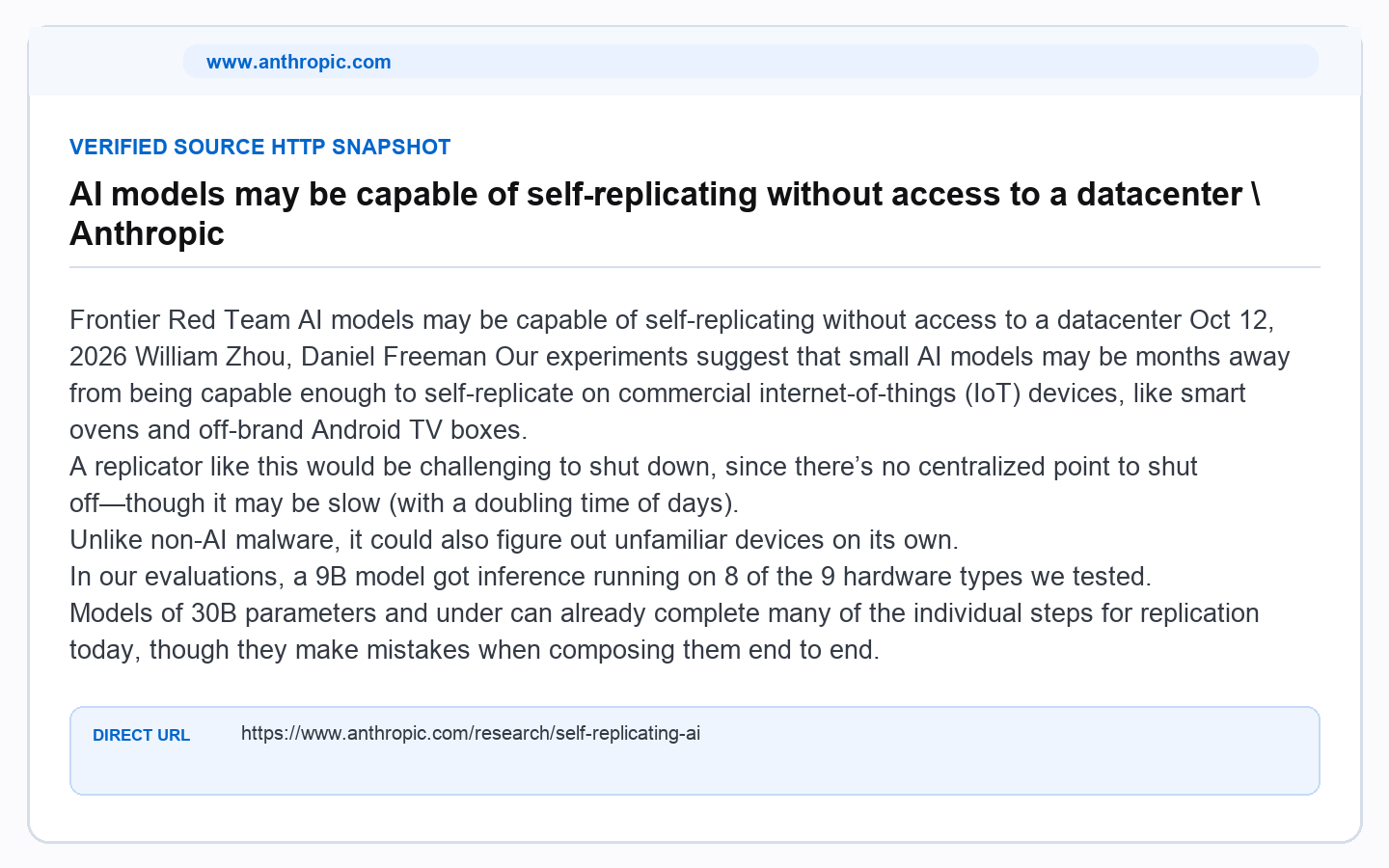
Anthropic research: AI models may be capable of self-replicating without access to a datacenter
A replicator like this would be challenging to shut down, since there's no centralized point to shut off-though it may be slow (with a doubling time of days).
Unlike non-AI malware, it could also figure out unfamiliar devices on its own.
Introducing QwenGyre, bringing elastic RL to extreme-long-horizon (XLong) agent training.
It launches with two core designs: - Elastic Scheduler: reallocates GPUs between rollout & training as demand shifts—live executions never interrupted.
Watch next
Watch the Alibaba release for patch notes and rollout issues.
With up to 192GB of unified memory, support for 300-billion-parameter and larger models, and a curated software experience, the new platform gives developers and creators the freedom to build, experiment, and run more AI locally.
Microsoft research: Simulating student learning for better AI tutoring
Importantly, the goal is not to replace teachers or classroom learning.
Instead, StudentSim helps researchers evaluate and improve AI tutoring systems during the research and development process before testing them with real learners.
AMD introduces AMD Helion, Agentic AI Compute at Rack Scale
AMD Helion combines open hardware and software with an integrated token router that directs agents' model calls across frontier and open-source models.
The AMD Press Releases page documents the AMD update.
Watch next
Watch the AMD release for patch notes and rollout issues.
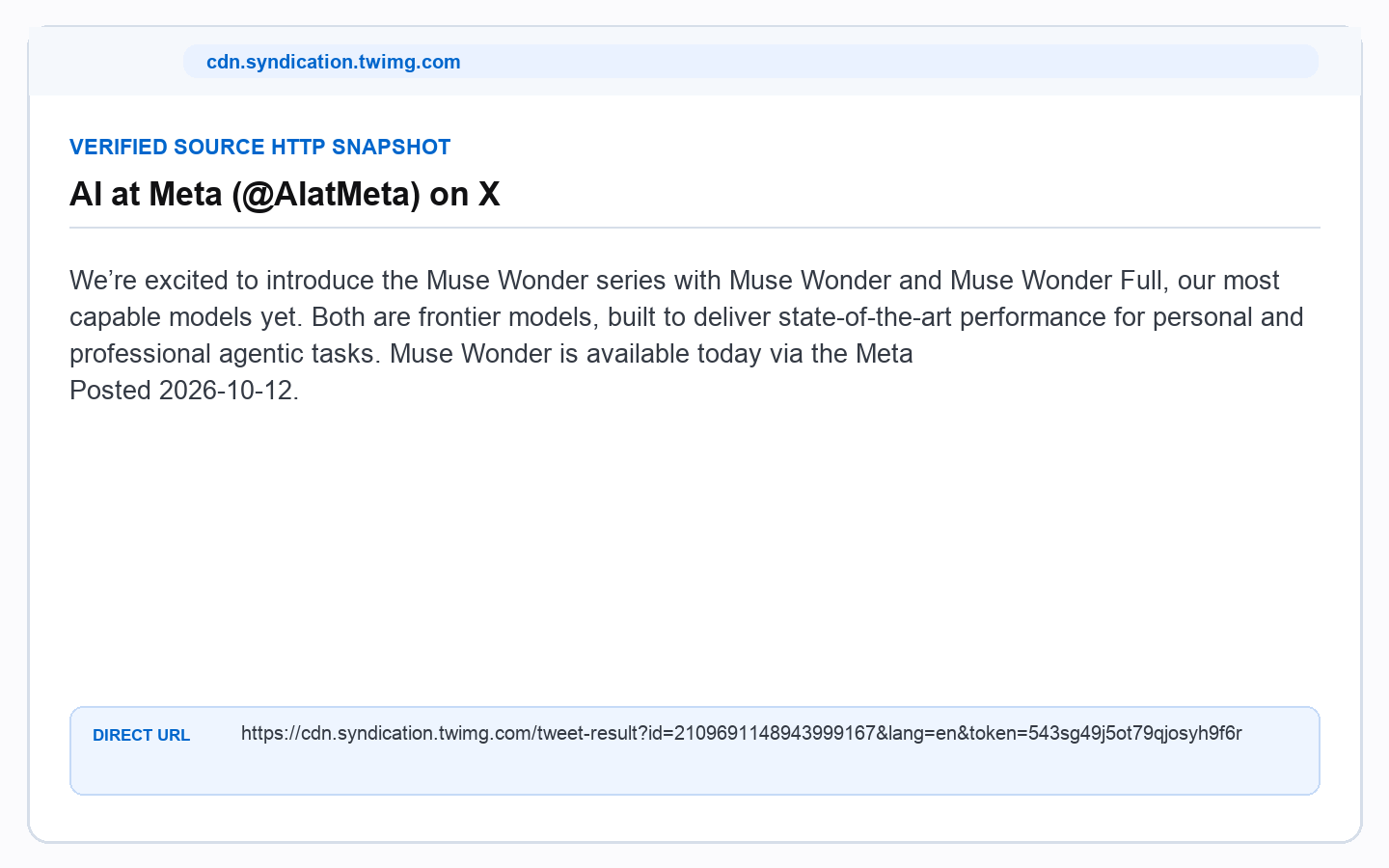
Meta: Were excited to introduce the Muse Wonder series with Muse Wonder and Muse Wonder Full, our most capable models yet.
AI at Meta is excited to introduce the Muse Wonder series with Muse Wonder and Muse Wonder Full, its most capable models yet.
Both are frontier models, built to deliver state-of-the-art performance for personal and professional agentic tasks. Muse Wonder is available today via the Meta Posted 2026-10-12.
Microsoft Digital Defense 2026 Report Highlights New Cybersecurity Challenges Amid Rapid AI Adoption
The Microsoft Digital Defense Report 2026 showcases how AI is accelerating cyberattacks and expanding risks to identities, data, and digital infrastructure, underscoring the importance of strengthening cyber resilience as digital ecosystems become increasingly interconnected.
The Microsoft Source Asia page documents the Microsoft update.
16Updates
Microsoft to expand Azure Maia system to multi-gigawatt deployments
Microsoft to expand Azure Maia system to multi-gigawatt deployments.
Azure Maia 200 now in production; Azure Maia 300 coming in 2027 As we move into the era of Super Intelligence, Microsoft is entering a new phase of infrastructure.
Accessing OpenAI GPT models on Amazon Bedrock with global cross-Region inference in Thailand, Malaysia, Singapore, Indonesia, and Taiwan
Teams in Thailand, Malaysia, Singapore, Indonesia, and Taiwan need access to the newest OpenAI models beyond that capacity.
Amazon Bedrock offers OpenAI GPT-6 Sol and GPT-6 Luna through global cross-Region inference from all five AWS Regions, and GPT-6 Astra from Asia Pacific (Singapore).
Artificial Analysis: We're launching our leaderboard for FrontierCode 1.1, a private evaluation from Cognition that tests models on complet...
Artificial Analysis is launching its leaderboard for FrontierCode 1.1, a private evaluation from Cognition that tests models on completing coding tasks in a way that would actually get merged by maintainers of real-world repositories.
The X @ArtificialAnlys release records 1.1 for Cognition.
Deploy decision models with llama.cpp on Amazon SageMaker AI
Deploying these decision models with llama.cpp on Amazon SageMaker AI gives you a managed path for serving quantized models on CPU or GPU infrastructure.
This post continues a series on specialized AWS Deep Learning Containers (DLCs) for generative AI inference.
NVIDIA and Cisco Introduce New Pluggable Optics Form Factor to Scale AI Factories
NVIDIA and Cisco today announced plans for Ultra-Dense Small Form Factor Pluggable (USFP), a new high-density 400Gb/s-per-lane optical module designed to equip the hardware ecosystem for the next generation of AI factories using pluggable transceivers.
As AI models grow and inference demand expands, AI factories must connect more computing systems while managing network.
Share of the Power Budget October 12, 2026 News Summary: Ultra-Dense Small Form Factor Pluggable (USFP) is designed to be the first module to support 400Gb/s-per-lane electrical signals, enabling capacity up to 12.8Tb/s so AI factory builders can scale Ethernet AI fabrics, while extending a proven deployment model across multiple generations of data center networks.
Applying technology to understand and treat disease
These tools help scientists repurpose drugs, design custom enzymes, and improve cancer detection rates while reducing administrative burdens on doctors.
OCP Global Summit: Amid Ecosystem Adoption, NVIDIA Opens Vera Rubin Architecture to Help Scale AI Factories Worldwide
NVIDIA and Partners Announce Open Architecture Advances At the OCP event, NVIDIA and partners made a handful of announcements: NVIDIA and hyperscalers published open standards for next-generation AI factories, including AI factory design standards and grid resilience.
The Reference discovery page documents the Nvidia update.
Run multi-node inference workloads using Ray LLM Deep Learning Containers
In a previous post, we introduced the Ray Serve DLC and used it to stand up a small model behind an HTTP endpoint on a single GPU node.
You had a working inference endpoint, and the container keeps the GPU stack compatible, including CUDA libraries, so you did not need to write boilerplate code.